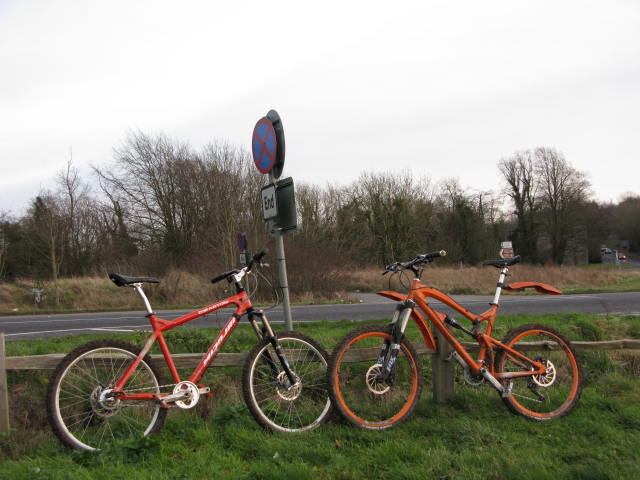
Horses for courses

With my trusty secateurs at the ready I plunged into the overgrown bridleway trying to find the remnants of a trail. Unpassable at present by bike or horse a few evenings work will open it once more.

This seems to be my primary training program this year as everything seems to be growing at a huge rate. While being stung and scratched it gives you a little mind wandering time, a bit like ‘walking promoting thinking’ with more sharp interuptions.

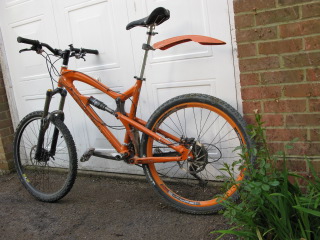
Just like everyone else I would like to ride faster and easier without earning the benefit from serious training so I have been comparing other bikes to my 33lb Nomad. Obviously a Blur is lighter, but not that much, so the key area for me is the fork. A Fox Vanilla 36 is great, but weighs about 2.5kg, whereas a Pace Fighter is nearer 1.5kg. In between at 2kg seems to be the compromise level for many others.

Other bikes, other forks and  other people’s opinions all help but there is no clear consensus as we all ride differently on different trails with different skills. So the best choice has to be ‘fit for purpose’  as although I might bounce off the odd lip or hang on down a washed out track I do not hurl myself off anything that would test a Nomad or a Vanilla 36.

Any big fork seems to be able to withstand large drops and heavy impacts and as a result tends to give a very soft ride on most trails with no handlebar buzz. A shorter travel fork tends to have a firmer edge but should stall less in a rooty hole or a ditch at low speed and be easier to manhandle due to its lower weight.

After a bit of changing of bikes and forks I find that the all mountain tag seems to combine lots of little details that suit a steeper fall line angle and a change of fork does not transform it into an xc whippet  nor does a big fork change a singletrack designed hardtail into a hardcore trail dropper.

So the answer seems to be more than one bike or horses for courses.

And as I drop my secateurs into my backpack  and turn to climb onto my saddle it seems I have been mistaken and at least one horse has passed through this particular bridleway and left some pungent proof on my front tyre.
Rear hub

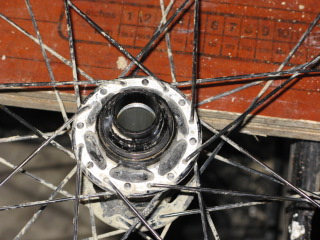
There are good instructions for different hubs, e.g. Hope, on the relevant manufacturers sites but for older designs then a mtb maintenance book (Steve Worland) or a magazine spread (Mountain Bike Rider) may be sufficent. Continue reading

front hub service

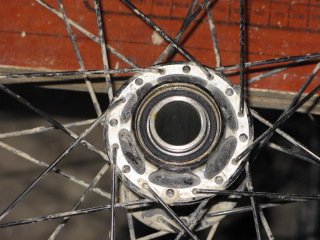
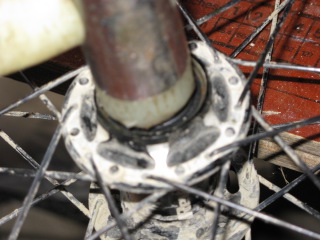
This is a quick service job on a 20mm DMR Revolver through hub. The bearings are sealed so replacement is required when you hub starts to sing to you on a quick downhill section.

Do not assume that your local bike shop will hold stock but the manufacturer’s site  will normally state the size and some show simple instructions for changing the bearings. The main internet suppliers will reply to a query about size and even offer you a part code.

If you are really keen then there are some sites which delve into bearing nomenclature and the delights of hoop stress and radial stress. Please allow me to bore you with this individually on a ride.

Hub showing the outer cup but with through axle removed

bearing in hub

gently tap out inner axle and bearing on lower side

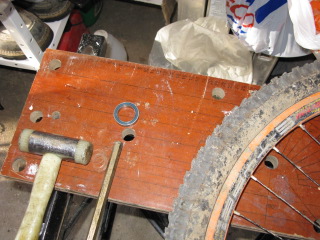
carefully tap out second bearing

tap in new bearings and axle using correct sized socket to prevent damage

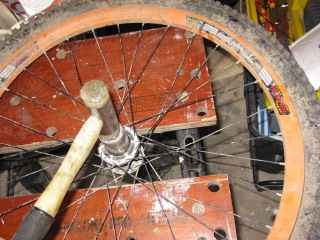
pressing bearings fully home

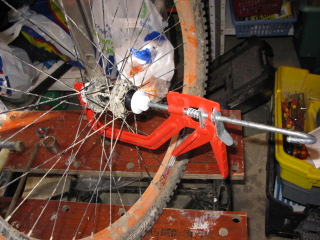
I fitted the external cups and gently pressed the bearings fully home. The manufacturers instructions suggested using the socket and hammer method but this seemed harsh. I did consider using a drill press or a vice but the correct tool is a bearing press. I used this ratchet clamp as a substitute.

Everything was cleaned and regreased at the appropriate points.

A quick service job that is less difficult than cup and cone as all the worn bits get replaced as a unit.

The old wolf still has teeth

It started so promisingly. Sunny evening, smiling faces, dry trails and plenty of time before darkess fell. We left Devil’s Dyke and headed towards Newtimber Hill and Wolstenbury Hill. Our new visitor Kevin skipped up the hills on his Specialized Stumpjumper with youth and fitness on his side. The tighter bridleway at Poynings will be a problem next winter but the revised line from Cow Down to Pyecombe is better than the old field edge line.

Just above the chalk bits I lost the rear mech pinch bolt. A cursory look around was fruitless so allowing the others to carry on I started the slow spin back. I had emergency lights in my backpack and so started to return on the West Road (A281) but I was so slow spinning it felt dangerous.

So I turned up the wolf ride. It is more worn now than a few years ago and the old wolf has lots its teeth but riding upwards it regained its’ bite. I did not make it up cleanly but I will return with gears to try again.

I ploughed my lonely furrow into the dusk with big fat drops of rain thudding into me as I wound my way back up the South Downs Way to the Dyke.

And it had all started so promisingly as well.

jobs,jobs,jobs

Spring was sprung in a flurry of snow and rain, summer seems to have arrived immediately, and all the maintenance jobs that have built up over the winter need to be completed before long summer days begin to shorten.

Some bikes may need virtual rebuilding of the transmission, forks, brakes, wheels and perhaps all the bearings and bushes in that clever linkage. Got a singlespeed, rigid forked hardtail and feeling smug? You still have a headset, bottom bracket, cables, and brakes. Obviously both hubs need servicing, wheels that need to be trued and maybe that maintenance free frame needs all the protective tape and patches replaced.

Forks seem to last almost forever nowadays until they fail and you fall off into a bomb hole at Pitch Hill. Some forks are less straightforward than others are when it comes to servicing and 36 Vanillas seems to need more than most. After checking component prices and even a tool or two perhaps consider a specialist like Mojo or TFShox. My Vanillas came back from Mojo with new lower legs, fully serviced and all for £100. So think about whether the service cost is reasonable especially considering the benefit of the warranty guarantee.

Rear shocks can seem perfect but when did you last even check the air pressure or the sag. Many shocks are an easy lubrication task with various guides in the bike magazines or online.

Brakes have improved dramatically over the last few years with all the latest models offering great stopping power and almost forget it reliability. However, mud, grit, rain, and damp storage are the perfect combination to encourage corrosion in even the most resistant alloys. Try removing your pads and pushing the pistons in your brake callipers fully home. You might have to allow some fluid release from the reservoir but also allows you to check carefully for signs of corrosion due to even the smallest of leaks and like your car they need re-bled occasionally or even the whole fluid changed. If you are lucky, you might just need to remove the pads and clean the springs before refitting. If it needs a little more then perhaps your local bike shop would appreciate the work.

Bottom brackets are easy to remove and now do not need complete rebuilding down to the smallest parts after a wet ride or two but a strip and re-grease will delay the time until replacement is required.
Headsets tend to work uncomplainingly but even the best units appreciate a wipe and some new grease. Cheaper models would be delighted with some new bearings too.

Transmissions are complex mechanisms that we want to be light, stiff, and smooth as silk when changing gear up a hill, in the mud under load. That chain that has had a bit of a clean and oil over the winter needs a close check for twisted links and for wear in its length. Use a chain gauge or a ruler to check the length for wear. Cassettes wear too so squint at all the rings. If the teeth look hooked then it needs replacement. While working at the rear hub take off the freehub and service it too. Replacement bearings and even axles are available and save loads of effort turning a worn hub up a hill.

Cables seem to look perfect even at the end of their life so if you want to check them cut off the cable end and pull them out of all the cable outers. If it is not almost perfect, new cables are cheap and easy to replace and it forces you to reset the indexing.

Front hubs require a clean and re-grease and bearings replaced occasionally.
Other parts seem maintenance free but check saddle rails for straightness and maybe a proper clean underneath and on top.

The seat post needs the clamp and bolt cleaned and regreased and the post itself checked for cracks.


Novice Racer

This was the first mtb race of my season, in fact, it was the first mtb race of my life, and it may well be my last. I had spent the previous week on bike choice and foolishly harboured the idea that an orange Nomad would give me an advantage on a technical course. In case this was unfounded, I had tried my 2003 Marin East Peak and although this was lighter on the climbs the Rockshox Pilot fork was the main weakness. A generous offer of a Blur LT seemed the sensible option and a comparison run or two over bridleways and a little off-piste illuminated the advantages of the VPP counter rotating links over a standard four bar configuration.
On this spring day, it seemed lovely and warm arriving at 10 a.m. and after a change of tyres and a puncture repair, I set ready for a practice lap.
Unfortunately, time was against me so I rolled around the field for a warm up before heading to the start line. A familiarity lap was probably unnecessary as the course would be clearly marked and I could take the first lap easy before powering through the last three laps finishing with a sprint to the line. Good plan that.
At the line, Mike was waiting on his Orange. Prudence said start slow and try to ride evenly paced and then the gun went and so did Mike. I had never seen that Orange go so fast and it was the last I saw of him for quite some time.
Using a heart monitor to ensure I would last four laps, I had determined an upper limit of 170 as a maximum so I immediately went to 180. I was in last place and I do not mean just behind a line of riders I mean ten metres behind after only one hundred metres. Unless Lance Armstrong’s old Motorola team were in disguise as a bunch of middle-aged men then it seemed a few people had started too quickly.
After a few minutes, I began to catch a few riders and as their adrenaline surge ended, the pace in front began to fade. I made progress through a few riders until a few of us missed a turn and we went the wrong way. At the road, we turned around and retraced out steps. We were last and a long way back now. Our race was over for the day and in the first lap so maybe a familiarity lap would have been better or even a few signs that said “Stop, not race route” for us race novices.
I spoke to several people on the way around and rode along with one of my fellow detourers who had the best encouragement of the day when several little people called “come on Grandad!” on every lap.
I also tagged along with one of the Southdown girls for a bit before she eventually pulled away as youth exerted its advantage.
My favourite bike of the day was not any of the lightweight carbon race machines but a Specialized in bright orange. Can’t think why exactly…
I was still running at 9mph according to my Garmin Gps readout and was remaining within my 170 heart rate limit but I could feel the hills and the heat were beginning to pay.
A few cheers at the start/finish line helped immeasurably but my legs had no zing after lap two.
So overall, would I recommend it to you? Perhaps, but only if you like racing your riding friends and you do not mind it hurting a bit.
I did learn that the advantage of a lightweight hardtail on the climbs offsets the lack of suspension in other areas; that weather conditions may be the most important factor as although the heat punished everyone the older and the least fit seemed to suffer disproportionately.
As for times and positions  Alec’s 2:41 was the best race time. Samantha Bryant who rode with some of us in Whiteways last year won the girl’s race and was second in the boys! However, the best point made to me was by Kim Bang Sorensen riding in his Sussex-mtb jersey when he said that Ian Petherbridge had won his group easily, with an improved margin from last year, in 2:12. Kim’s own 2:38 put him in second place again but the fact he pointed out his rival’s achievement rather than his own was a generous touch.
As for my own lowly 16th, I learned that Father Time has caught and well and truly passed me.