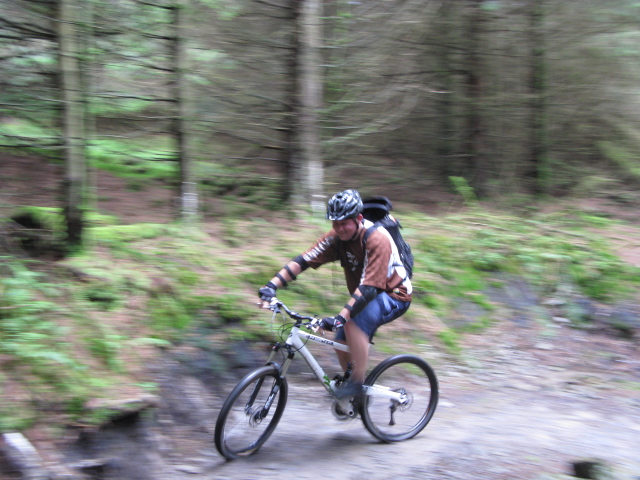
Penhydd

Over lunch on Saturday afternoon at Glyncorrwg we decided to go down the valley to the original Afan trails.

We drove down the valley but you can ride down along the riverbank but of course you would have to ride back up the valley at the end of the day.
The Penhydd is less exciting than the White’s level but more fun perhaps. It does not have the same long initial climb but instead it rocks and rolls through the trees. There are plenty of climbs but as they are not continuous they feel easier.

There are some obstacles and some challenging sections especially if you try to follow the flow of the trail builder and run without braking. My only regular complaint on all man made trails is that some of the hairpins are so tight for the longer frames you are almost stationary at times and the evidence is there to show the exit lines of the unwary.
The Penhydd encourages you to ride continuously from section to section without stopping for food or photographs and is suitable for the less experienced although we would still recommend riding in pads.
Some thought this the best ride of the long weekend with enough fast singletrack to stretch your abilities without punishing you unnecessarily on steep climbs.
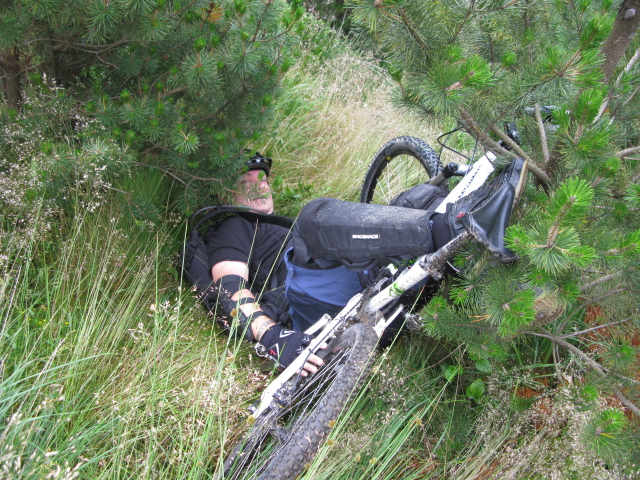
There is an important lesson here though. If you want to be in all the photographs make sure that you are first up the climb AFTER the photographer.
Horses for courses

With my trusty secateurs at the ready I plunged into the overgrown bridleway trying to find the remnants of a trail. Unpassable at present by bike or horse a few evenings work will open it once more.

This seems to be my primary training program this year as everything seems to be growing at a huge rate. While being stung and scratched it gives you a little mind wandering time, a bit like ‘walking promoting thinking’ with more sharp interuptions.

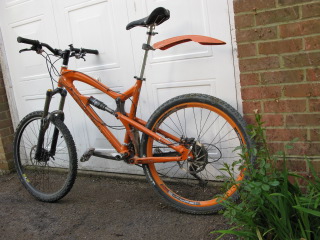
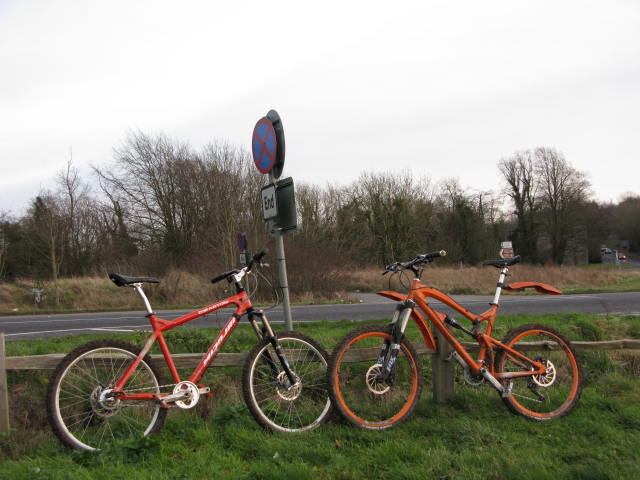
Just like everyone else I would like to ride faster and easier without earning the benefit from serious training so I have been comparing other bikes to my 33lb Nomad. Obviously a Blur is lighter, but not that much, so the key area for me is the fork. A Fox Vanilla 36 is great, but weighs about 2.5kg, whereas a Pace Fighter is nearer 1.5kg. In between at 2kg seems to be the compromise level for many others.

Other bikes, other forks and  other people’s opinions all help but there is no clear consensus as we all ride differently on different trails with different skills. So the best choice has to be ‘fit for purpose’  as although I might bounce off the odd lip or hang on down a washed out track I do not hurl myself off anything that would test a Nomad or a Vanilla 36.

Any big fork seems to be able to withstand large drops and heavy impacts and as a result tends to give a very soft ride on most trails with no handlebar buzz. A shorter travel fork tends to have a firmer edge but should stall less in a rooty hole or a ditch at low speed and be easier to manhandle due to its lower weight.

After a bit of changing of bikes and forks I find that the all mountain tag seems to combine lots of little details that suit a steeper fall line angle and a change of fork does not transform it into an xc whippet  nor does a big fork change a singletrack designed hardtail into a hardcore trail dropper.

So the answer seems to be more than one bike or horses for courses.

And as I drop my secateurs into my backpack  and turn to climb onto my saddle it seems I have been mistaken and at least one horse has passed through this particular bridleway and left some pungent proof on my front tyre.

Rear hub

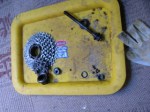
There are good instructions for different hubs, e.g. Hope, on the relevant manufacturers sites but for older designs then a mtb maintenance book (Steve Worland) or a magazine spread (Mountain Bike Rider) may be sufficent. Continue reading

front hub service

This is a quick service job on a 20mm DMR Revolver through hub. The bearings are sealed so replacement is required when you hub starts to sing to you on a quick downhill section.

Do not assume that your local bike shop will hold stock but the manufacturer’s site  will normally state the size and some show simple instructions for changing the bearings. The main internet suppliers will reply to a query about size and even offer you a part code.

If you are really keen then there are some sites which delve into bearing nomenclature and the delights of hoop stress and radial stress. Please allow me to bore you with this individually on a ride.

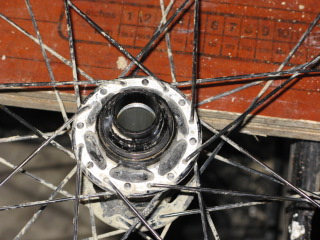
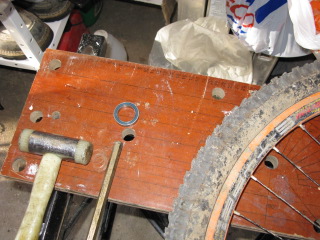
Hub showing the outer cup but with through axle removed

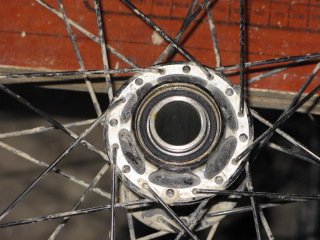
bearing in hub

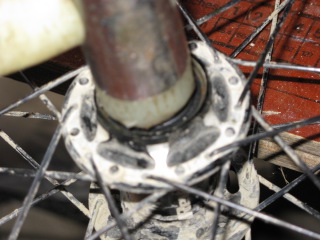
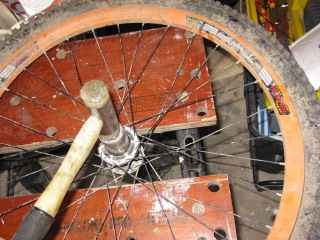
gently tap out inner axle and bearing on lower side

carefully tap out second bearing

tap in new bearings and axle using correct sized socket to prevent damage

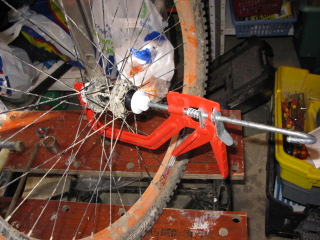
pressing bearings fully home

I fitted the external cups and gently pressed the bearings fully home. The manufacturers instructions suggested using the socket and hammer method but this seemed harsh. I did consider using a drill press or a vice but the correct tool is a bearing press. I used this ratchet clamp as a substitute.

Everything was cleaned and regreased at the appropriate points.

A quick service job that is less difficult than cup and cone as all the worn bits get replaced as a unit.